LIN 105: Language Learning in Humans and Machines
| Instructor | Class Day/Time | Location | Office Hours | Office | |
| Masoud Jasbi | Tue + Thu 12:10-1:30 | GIEDT 1006 | jasbi@ucdavis.edu | Tue 2-3 | Kerr 279 |
Schedule
Course Objectives
| Objective | Course Component | |
| 1 | Introduce the foundations of computational learning models | Readings, Lectures |
| 2 | Introduce the basic findings in children's language development | Readings, Lectures |
| 3 | Practice critical and scientific thinking and research | Assessment |
Syllabus
| Assessment | |||||
| Research Skills | 100 Points | ||||
| Reserach Question and Bibliography | 10 Points | A one page bullet point presentation of the research question for your project and the papers you plan to read on it. | |||
| Introduction of the Research Question and Literature Review | 20 Points | A two page document presenting the research question and summarizing prior literature on it. | |||
| Research Proposal | 30 Points | A two page document presenting the research question, summarizing prior literautre, and proposing methods for your study and the results you expect. | |||
| Final Presentation | 40 Points | A 7 minute flash-talk presentation of your resarch question, prior literature, proposed methods for your study and results you expect followed with a 7 minute Q and A. | |||
| Policies | |||||
| Groups | You can do your research assignment individually or form groups with other students. Group submissions must also submit a separate page explaining author contributions. You can see an example of author contribution in scientific journal by clicking on this link. You should also mention whether authors have had roughly equal contribution in your judgment and the grade should be distributed equally or not. Common examples of unequal contribution are members missing meetings and work sessions of the group frequently or being completely absent and unresponsive until deadlines or even after. Disputes will be resolved on a case by case basis. | ||||
| Late Submission | Late assignments will be graded as though they were not late, but then 5% of the grade earned will be deducted for each day the assignment is late, with a maximum penalty of 50%. All late work must be turned in by the Friday before your final exam. This policy can be waived if lateness is due to medical reasons or other special circumstances. | ||||
| Submission Format | Submit your assignments using Canvas. Files should be in PDF. Typed assignments should use Times New Roman (12pt), 1 inch margins, 1.5 line spacing. Do not include your name or any identifying information in the assignment. In order to avoid grading biases, assignments are graded anonymously. | ||||
| Grading | We use the following grading scale: A+ = 100-97 A = 97-93, A- = 93-90, B+ = 90-87, B = 87-83, B- = 83-80, C+ = 80-77, C = 77-73, C- = 73-70, D+ = 70-67, D = 67-63, D- = 63-60, F = 60-0. For any submission, if you believe there have been grading mistakes, you can ask for re-grading. The assignment will be graded by a new grader and the second grade will be recorded. |
||||
| Integrity | We follow the UC Davis code of academic conduct. You are permitted to work together on the assignments. However, you must write up and submit your own unique assignments. | ||||
| Accessibility | Students who may need an academic accommodation based on the impact of a disability must initiate the request with the UC Davis Student Disability Center. Professional staff will evaluate the request, recommend reasonable accommodations, and prepare a letter of accommodation for the faculty. Students should contact the SDC as soon as possible since timely notice is needed to coordinate accommodations. | ||||
| Addressing the Instructor | I prefer Masoud and he/his/him for pronouns. No titles or last name needed. | ||||
| Philosophy | |||||
| Participation | We believe that our class benefits enormously from you sharing your thoughts and questions. Your background, life experiences, knowledge, thoughts, and ideas make you unique, and our classroom diverse. This diversity of perspectives is the foundation of learning in a classroom. At a larger scale and within a scientific community, it is also a major contributor to scientific progress. Therefore, sharing your thoughts and questions can help us learn and build a wider, stronger community of scholars. Some of you may worry that your classmate's asking questions and sharing ideas may disrupt the class progress. Judging when to ask a question or share an idea is tricky but also part of education. Instead of discouraging it, we would like to practice it together. Here is flowchart that you might find useful. Ultimately, we trust your judgments. 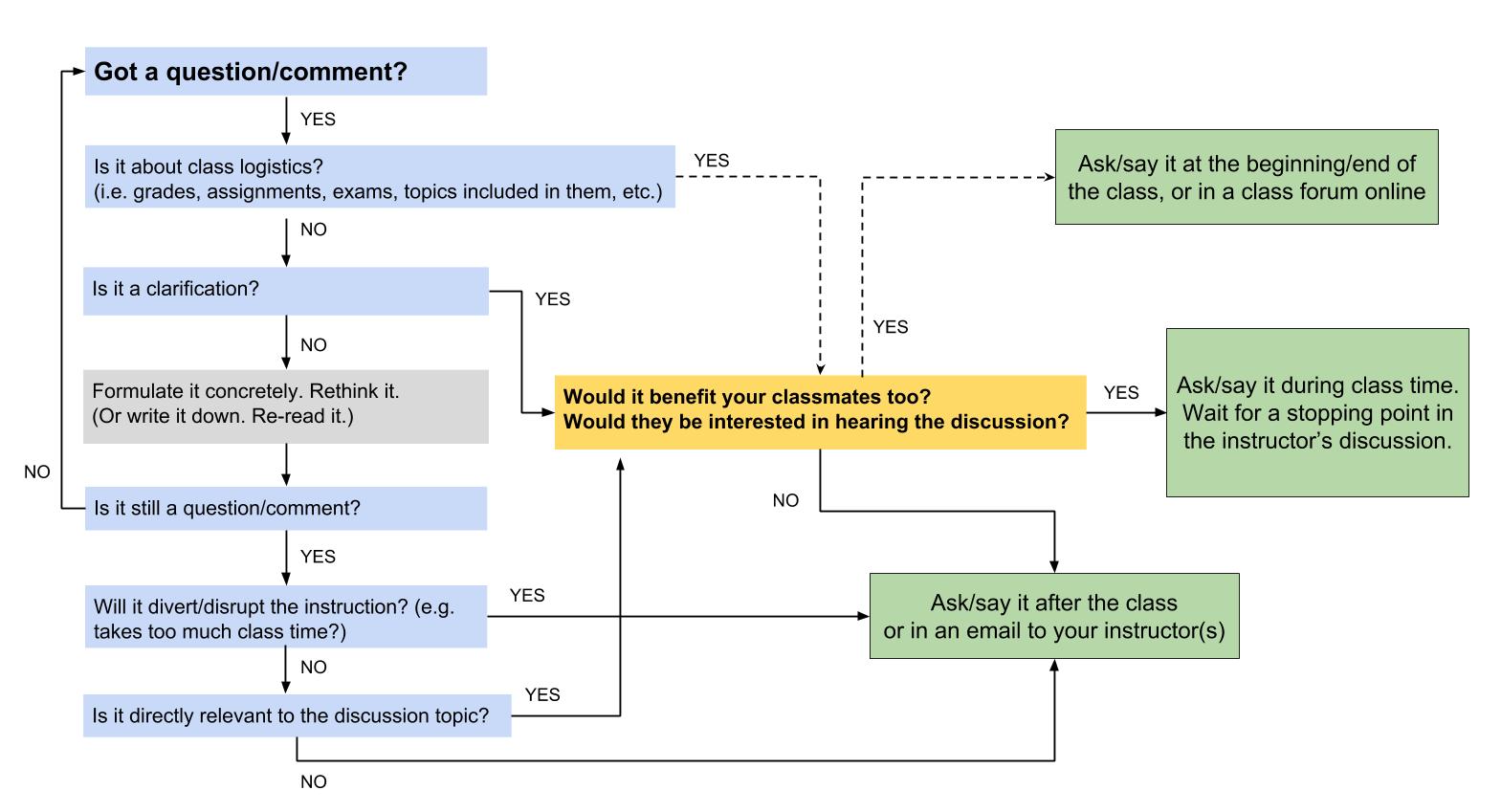
|
||||
| Questions | We genuinly believe that there are no "stupid" questions in a classroom. The point of going to a class is to learn together and questions are our best tool to achieve that. It is easy to show that your question will help us learn no matter what. Your question is either: (1) not framed well; in which case you give us a chance to explain the topic better. Chances are we did not explain it well the first time and many of your classmates are wondering about it too. (2) framed well and has an answer we know; in which case we can help you as well as your classmates who have the same question learn it too! You have also helped us consolidate our knowledge by explaining it again. (3) framed well but has an answer we do not know; in which case we can find the answer together and your question has helped all of us learn! (4) framed well and does not have an answer yet; in which case you found a research topic someone can start working on and benefit the field! As you see, your question has helped our learning either way. So please ask! |
||||